Was It Worth It? The Psychology of Playing It Safe in Love
Was It Worth It? The Psychology of Playing It Safe in Love
I just got home from a six-day ski trip that was absolutely wonderful…
And then I got sick for another six days.
I’m still not totally out of the woods, honestly.
Life threw me a curveball the minute I returned.
And it made me ask the question we all ask at some point:
Was it worth it?
And the answer is… completely.
It was Michael’s birthday, and he loves being in the mountains with his daughter, her husband, and the twins. Watching him in that space—present, joyful, connected—reminded me why we take the trip every year.
Because some experiences are worth the risk.
Travel always comes with unknowns.
Delays at the airport. Getting sick. Getting stranded. Even the possibility of getting hurt skiing.
And yet… we go anyway.
Because we want a certain kind of life.
And it made me think about how often we do the opposite in love.
The Psychology of Playing It Safe
One of the most common emotional patterns I see in dating—and even in marriage—is the temptation to play it safe.
To avoid the risk.
To protect yourself from the discomfort of uncertainty.
Maybe it looks like not texting him back because you don’t want to seem too eager.
Or not bringing up the question because you’re afraid of the answer.
Or keeping your heart slightly guarded… just in case.
It’s so human.
Our brains are wired to avoid emotional pain.
And vulnerability always comes with risk.
But the truth is:
Playing it safe doesn’t actually keep you safe.
It keeps you small.
In Dating, “Safe” Becomes Self-Protection
In dating, playing it safe often sounds like:
“I don’t want to get hurt again.”
“I don’t want to look foolish.”
“I’ll wait and see what he does.”
But what’s happening underneath is something deeper:
Your nervous system is trying to prevent rejection by staying slightly disconnected.
And the cost is… you never fully show up.
In Marriage, “Safe” Becomes Distance
Even in long-term love, playing it safe can show up too.
We stop initiating.
We stop sharing what we really feel.
We avoid hard conversations.
We assume love should be effortless, and when it isn’t, we retreat.
But intimacy doesn’t thrive in avoidance.
It thrives in presence.
What I’ve Learned With Michael
One of the things I’ve learned over the years in my marriage is that love is not something you “arrive at” and then stop tending.
Even with a wonderful partner, you still have moments where it feels easier to shut down than to stay open.
You still have moments where you could choose distance…
Or you could choose connection.
Michael and I have had to practice that—coming back to each other, speaking honestly, taking emotional risks, even in small ways.
Because the deepest love isn’t built through perfection.
It’s built through presence.
Through continuing to show up.
The Greater the Risk, the Greater the Experience
That ski trip reminded me:
A meaningful life requires risk.
A meaningful relationship requires risk.
Not reckless risk…
But the willingness to stay open even when life feels uncertain.
This time of year especially, there’s something in the air.
A new beginning.
A quiet invitation to stick your neck out again.
To have the conversation.
To try again.
To go on the date.
To soften instead of shut down.
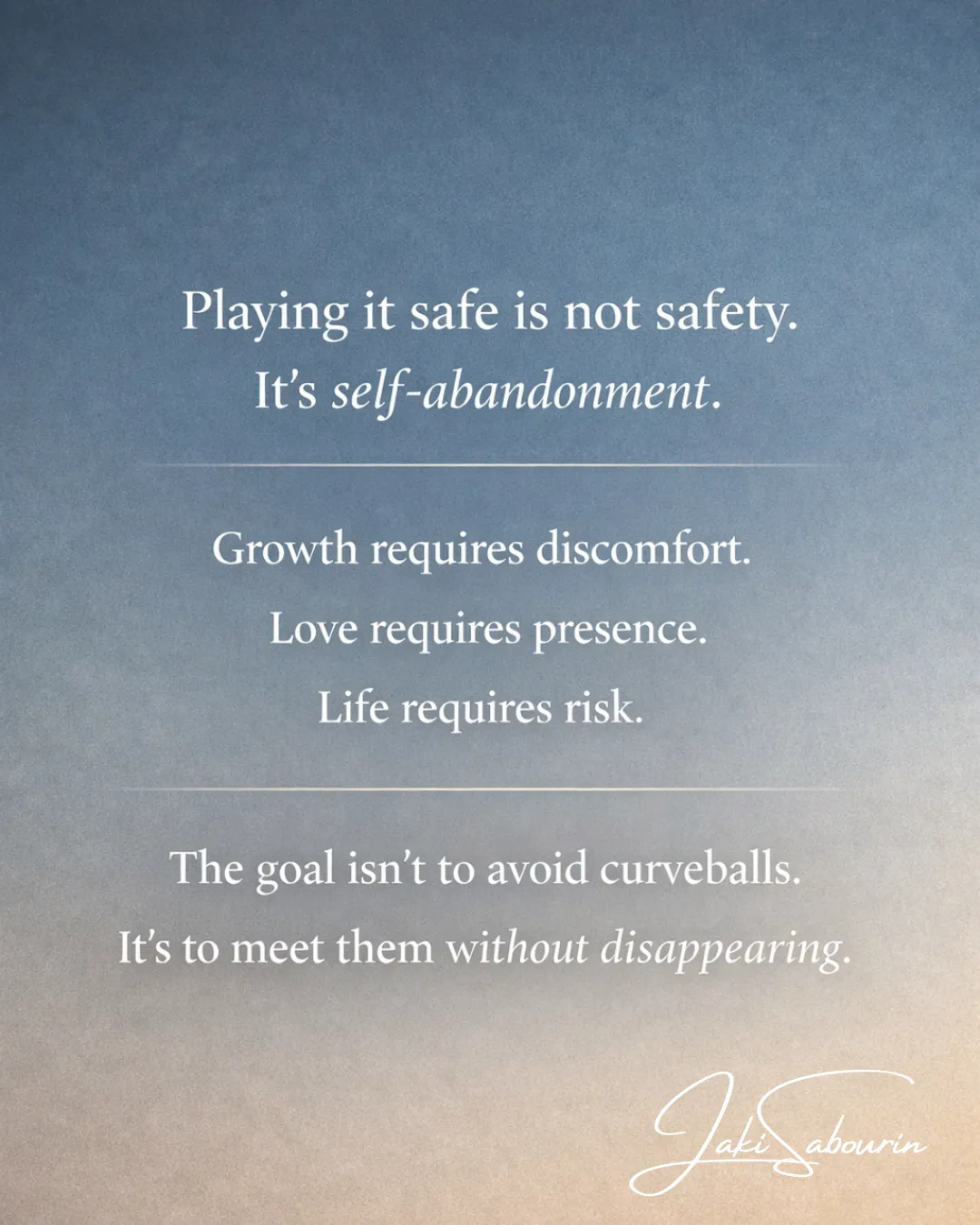
Curveballs will come.
They always do.
But the question isn’t:
“Can I avoid them?”
The question is:
“How do I meet life when they arrive?”
Because maybe the curveball doesn’t mean you were wrong to try.
Maybe it means you’re living.
And love—real love—requires that.
Sending you so much love,
Jaki